Genie 3 debuts
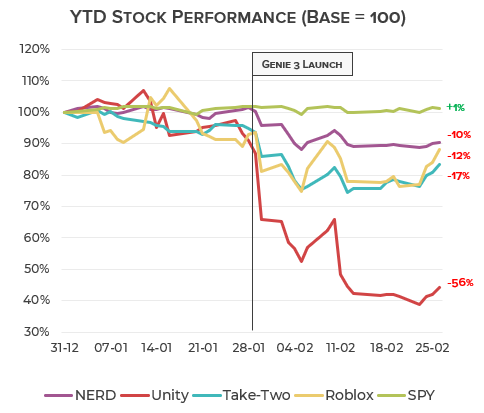
- Earlier this year, Google’s new Genie 3 product launch sparked fear among investors for a new disruption in the gaming industry.
- Although the market has likely been aware of high-level AI development tools operating behind closed doors for some time, a major AI incumbent’s release of a fully dedicated gaming tool has brought the industry’s potential risks into public view.
- Roundhill Video Games ETF (NERD), which tracks global video games and esports companies, fell -11% YTD following the Genie 3 launch.
- Unity was the worst affected among gaming, with its market valuation dropping 58% YTD as its business model is the most threatened by the new game development tool.
Emerging theses on AI
- With more gaming-focused AI products coming to market, the discussion on AI’s impact has matured, shifting from speculative debate to more structured theses.
- Amid the recent market dip following the release of Genie 3, the prevailing argument centered on the democratization shock case, where small teams could build high-production-value games, rendering the technical barriers and know-how of incumbents less relevant.
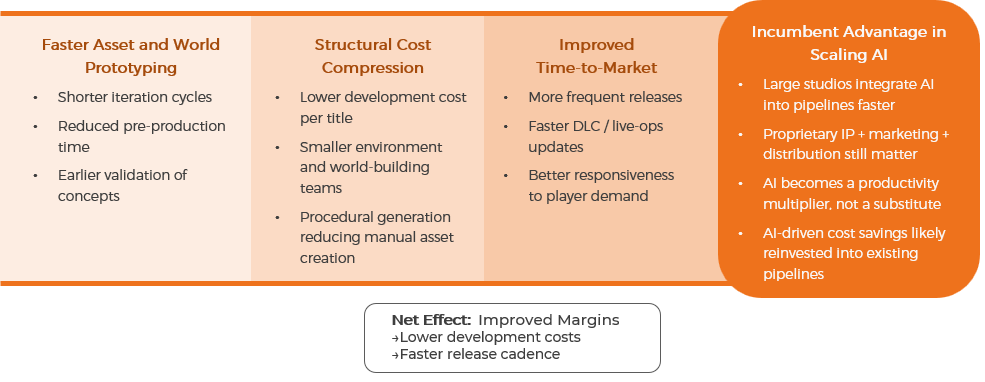
- However, the more widely accepted thesis within the industry is that new AI tools will drive creative destruction, reducing development costs and time to market, and ultimately supporting higher-margin business models.
- Both cases are discussed in the following pages.
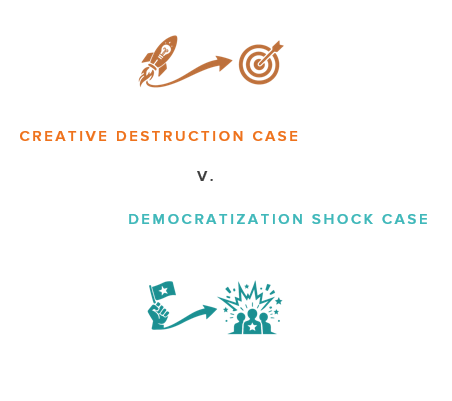
Creative destruction case
Google’s Genie 3 has unsettled investors. However, AI worldbuilding tools, if developed and adopted as 3D asset generators by incumbents, could ultimately reduce production costs and shorten time to market.
Democratization shock case
Most investors fear that emerging AI worldbuilding tools will become broadly accessible, lowering barriers to entry and democratizing high-production game development, which could destabilize current incumbents’ competitive positioning. 
Moves in AI-Driven Game production
- While widespread production-grade adoption of Gen AI remains distant, companies that control game production ecosystems are now actively embedding generative AI tools into their development ecosystems.
- Roblox introduced an open beta of its 4D creation tools, extending gen AI beyond static assets to interactive, physics-aware objects — signaling a gradual shift toward real-time, player-influenced content generation at scale.
- Unity is set to unveil upgraded Unity AI tools at GDC, reportedly capable of generating fully finished casual games from prompts.
- Epic and other technology companies are expected to follow soon, though such tools are unlikely to meet the quality standards required by major incumbents in the near term.
The lack of distinctiveness
- The recent stock selloff appears to reflect an overreaction to the current state of the technology, even if longer-term structural concerns remain valid.
- Notably, Genie 3 does not generate true 3D models or structured game assets; instead, it produces an interactive, player-responsive video stream—effectively generating pixels rather than underlying geometry.
- A key silver lining for AI tools breaking tech barriers is that high-fidelity visuals are increasingly accessible to smaller teams due to advancements in game engines, as discussed in IDG’s July 2025 report.
- IDG has consistently argued that differentiation in gaming is shifting toward areas such as distinctive gameplay design, art direction, and narrative, which are becoming more important drivers of discoverability than pure production scale and fidelity.
- The lack of distinctiveness in AI-generated output remains its Achilles’ heel, but newer AI tools will undoubtedly make 3D object and environment creation significantly faster, providing a base layer that developers can further refine and customize to achieve more distinctive results.
AI Impressions & Effects on Gaming
Gen Z gamers in China, Brazil, and Germany had much more positive impressions of AI than their counterparts in the US.

EXCERPT FROM IDG INTELLIGENCE · February 2026 GAMES REPORT · Console FORECAST UPDATE


